For Individual Providers
You treat patients. We fill the forms.
Getting in network solo means the same 40 fields typed into every payer portal, then months of silence. With PayerReady you build one profile, a named specialist prepares and submits every application, and your dashboard shows the true status of each one. No more wondering if anyone is working on it.
Next follow up: Thursday
Every payer chased on schedule
Your panel, built while you practice
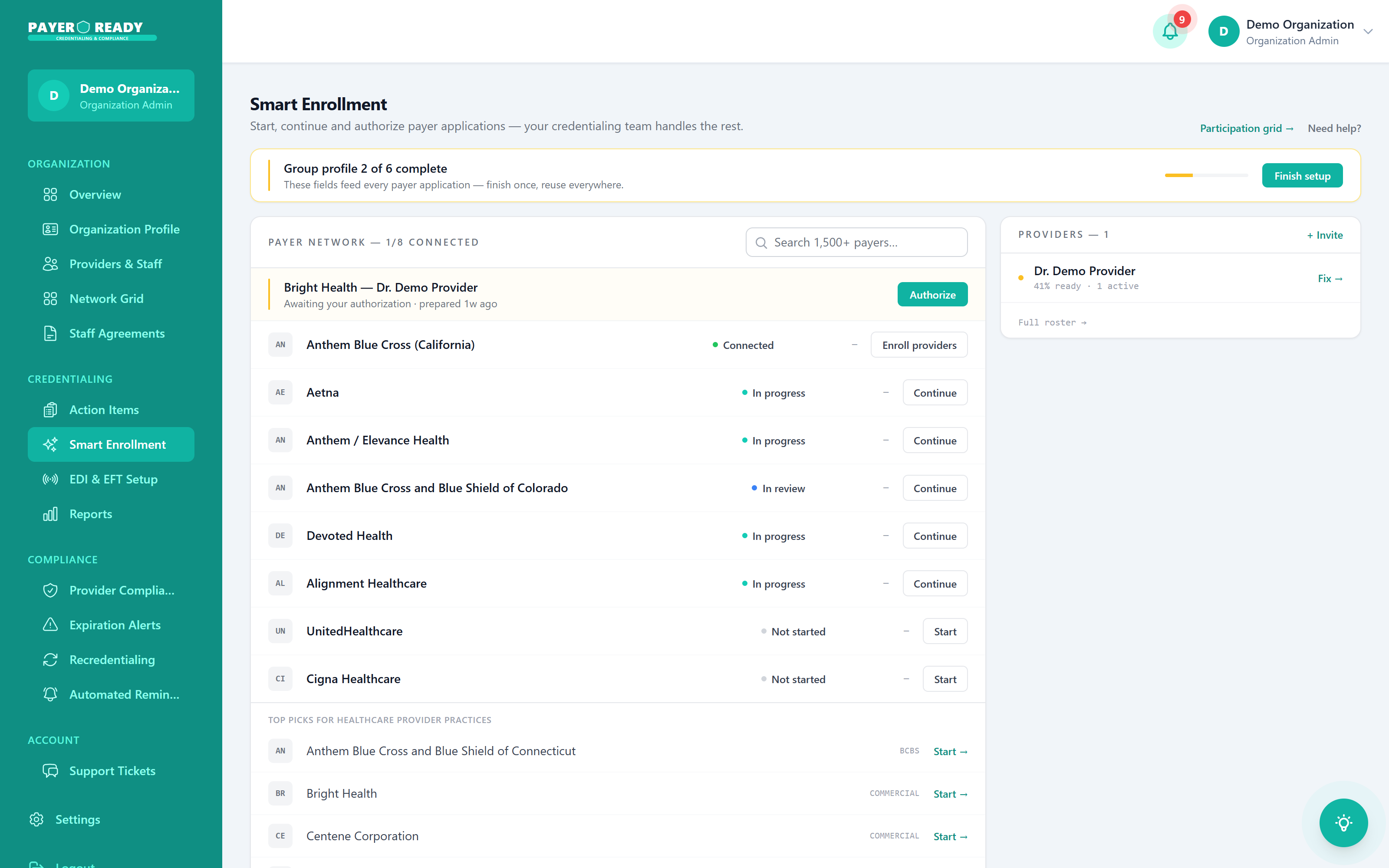
One profile on the left. Every payer that matters on the right. Watch the connections land, one approved application at a time.
What running solo looks like with a team behind you
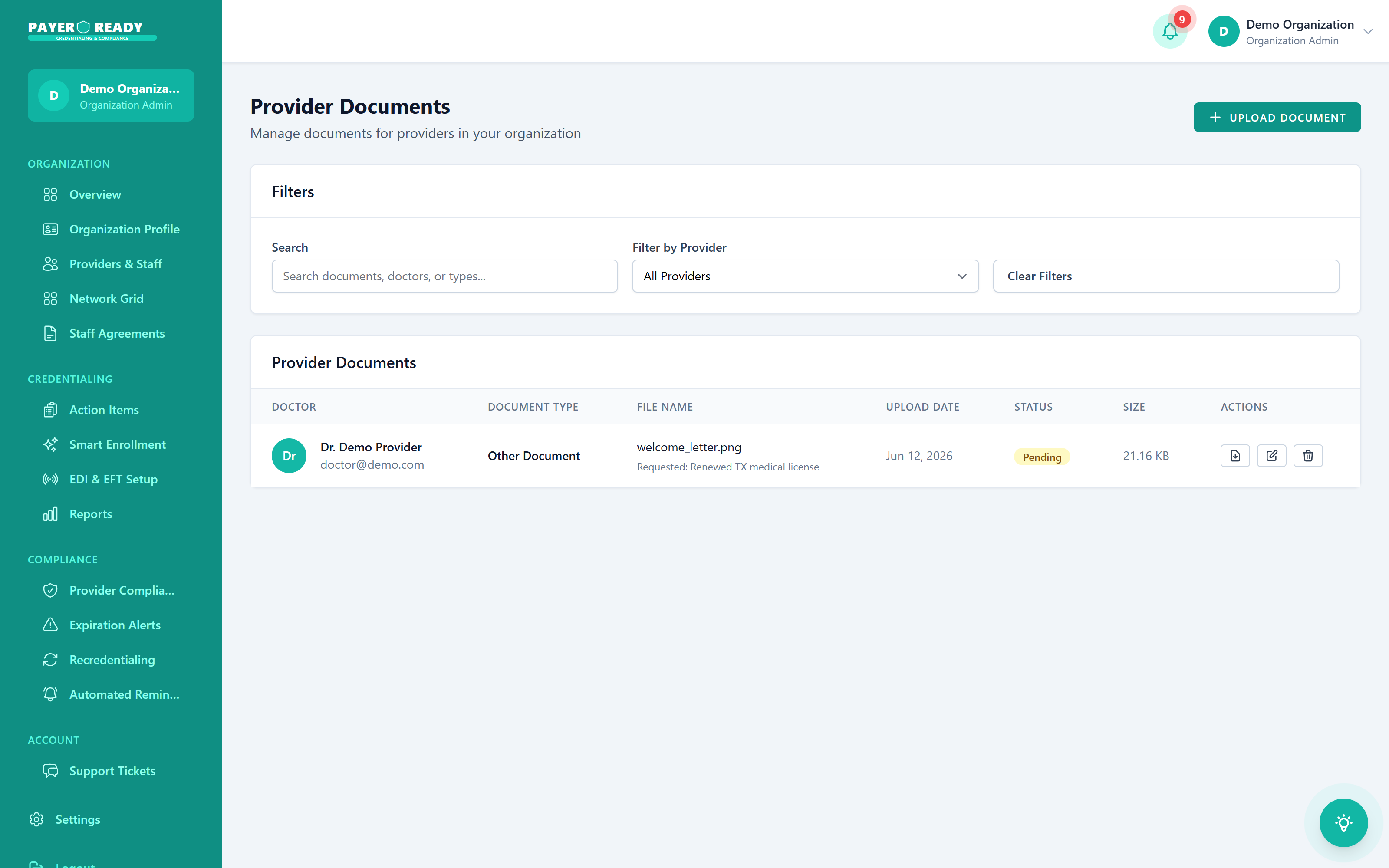
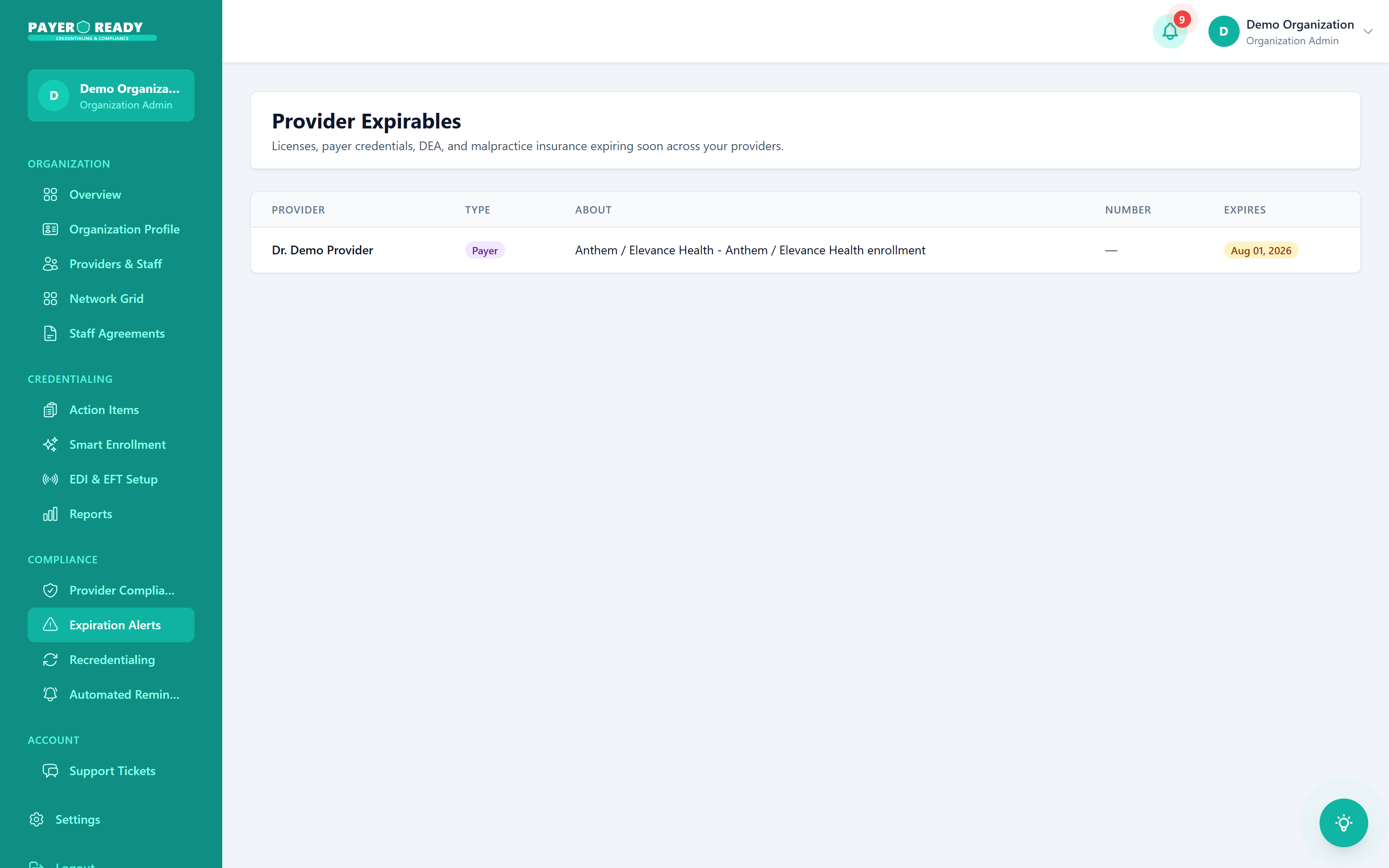
Real screens from the platform, not mockups. This is your actual dashboard.
Every document, uploaded once, used forever
Your license, DEA, malpractice face sheet, board certificates, CV: they live in one vault. When a payer wants a copy, your specialist pulls it from your file instead of emailing you at 9pm. When something is about to expire, you hear about it at 90, 60, and 30 days.
- Document AI reads uploads and fills your profile from them
- Expiration alerts at 90, 60, and 30 days
- Requests come as tasks, not lost emails
Renewals stop ambushing you
A lapsed license or a missed CAQH re-attestation stops your billing cold. Your dashboard watches every date: state license, DEA, board certification, malpractice, CAQH. You renew calmly on your schedule instead of discovering the lapse from a denied claim.
- CAQH re-attestation windows tracked for you
- License and DEA renewals surfaced early
- One Overview tab with everything pending
What going it alone actually costs
Solo providers pay for credentialing three times: in evenings lost to portals, in months of unbillable encounters, and in renewals that slip. All three are avoidable.
The same 40 fields, every portal
CAQH ProView wants your work history one way, PECOS another, each commercial portal a third. Typed by hand after clinic hours, every re-entry is a fresh chance to introduce the typo that becomes a 30 day rejection letter. One verified profile, entered once, ends the cycle.
Every unenrolled month is unbilled care
Patients with UnitedHealthcare, Aetna, or Medicaid cannot use their coverage with you until the payer says you are in network. For a solo practice, each payer left unworked is a slice of the local patient population you either turn away or see out of network. Time to par status is revenue math.
Renewals do not send reminders
CAQH re-attestation comes due every 120 days. DEA registration renews on a three year cycle, state licenses on their own calendars, malpractice annually. Miss any one and claims stop paying until it is cured, sometimes with recoupment of what was already paid. A watched calendar is not optional at any practice size.
Everything a solo file needs, handled
The full scope of the work, whether you bring one payer or fifteen.
CAQH ProView management
Your profile built or repaired, attestations kept current on the 120 day cycle, and payer authorizations maintained so plans can actually pull your file.
Medicare and Medicaid enrollment
PECOS filings for Medicare, state portal applications for Medicaid, revalidations included. The government payers, done by people who file them weekly.
Commercial payer applications
UnitedHealthcare, Aetna, Cigna, BCBS plans, Humana, and the regional plans your patients actually carry, each prepared against that payer's specific requirements.
Document vault with Document AI
Upload a license or a malpractice face sheet and Document AI reads it, files it, and fills the matching profile fields. Requests arrive as tasks, never as lost emails.
Expiration watching
State license, DEA, board certification, malpractice, CAQH: every date on your file alarmed at 90, 60, and 30 days, on your dashboard and in your inbox.
A named specialist, not a queue
One person owns your file, follows up with every payer on a two week cadence, and logs each response where you can read it. You know their name and they know your file.
Your first 90 days, mapped
No mystery phases. This is the cadence your file actually moves on.
Days 1 to 3
Profile and packet
You create your free account, your NPI pulls NPPES data, Document AI ingests your uploads, and your specialist verifies the packet payer by payer.
Week 1
Applications out
CAQH built or repaired and attested. PECOS and commercial applications submitted against each payer's specific checklist, cover sheets included.
Weeks 2 to 10
Worked, not waiting
Every payer contacted on a two week cadence. Each response logged on your file. Deficiencies cured the week they surface instead of the month they are noticed.
Days 60 to 90
Par status lands
Approvals arrive with effective dates locked and recorded. Your dashboard flips to in network, and the file rolls into permanent expiration watching.
For solo providers
The math of not doing this alone
What changes when a named specialist owns your file and the follow up cadence never slips.
$0
to sign up, no subscription required
A free account, and the exact price visible on every application before it is billed.
0
profile feeding every application
CAQH ProView, PECOS, and every commercial portal pull from the same verified record.
60 to 0
days typical to in network and billing
The industry norm without follow up runs 120 to 180. The difference is the cadence, not luck.
0 weeks
maximum between payer follow ups
Every payer response logged on your file, where you can read it whenever you want.
Solo provider questions, answered straight
The things providers ask before trusting anyone with their enrollment.
You own all of it. Your profile is yours to update whenever you need to, and nobody else can change your data without your permission. If you ever join a group, you decide what gets shared with their organization.
You fill out your profile once. After that, your data populates every credentialing and enrollment form: CAQH, PECOS, commercial payer applications, state Medicaid. No more re-entering the same information for different payers or states.
Yes. Your data is stored on a HIPAA-compliant platform with encryption and strict access controls. Only you and any organization you explicitly authorize can view it.
Your at-a-glance summary: pending applications, pending licenses, upcoming expirations, and any open tasks. You see exactly where everything stands without clicking through multiple screens or emailing anyone for a status.
Signup is free and there is no subscription required to start. You pay per payer application, $119 to $149 each depending on volume, and you see the exact price before anything is billed. Enroll with five payers, pay for five applications. That is the whole model.
Yes, and this is the part solo providers notice most. Every payer gets followed up on a two week cadence and every response is logged on your file. You watch status change from submitted to in review to approved on your dashboard instead of wondering if anyone is working on it.