For RCM Organizations
You bill. We keep the providers billable.
Every denial that traces back to a lapsed license, a stale CAQH attestation, or an enrollment nobody finished is revenue your team eats. PayerReady runs credentialing for your client practices upstream of your billing, so the claims you submit are backed by current credentials the first time.
Denials prevented upstream
Credentials verified before claims
The same claim, two credentialing realities
Top lane: the claim rides on stale credentials and dies at adjudication. Bottom lane: credentials verified upstream, claim pays the first time.
Every client roster, one console
Real screens from the platform your team would work in, across every client practice you manage.
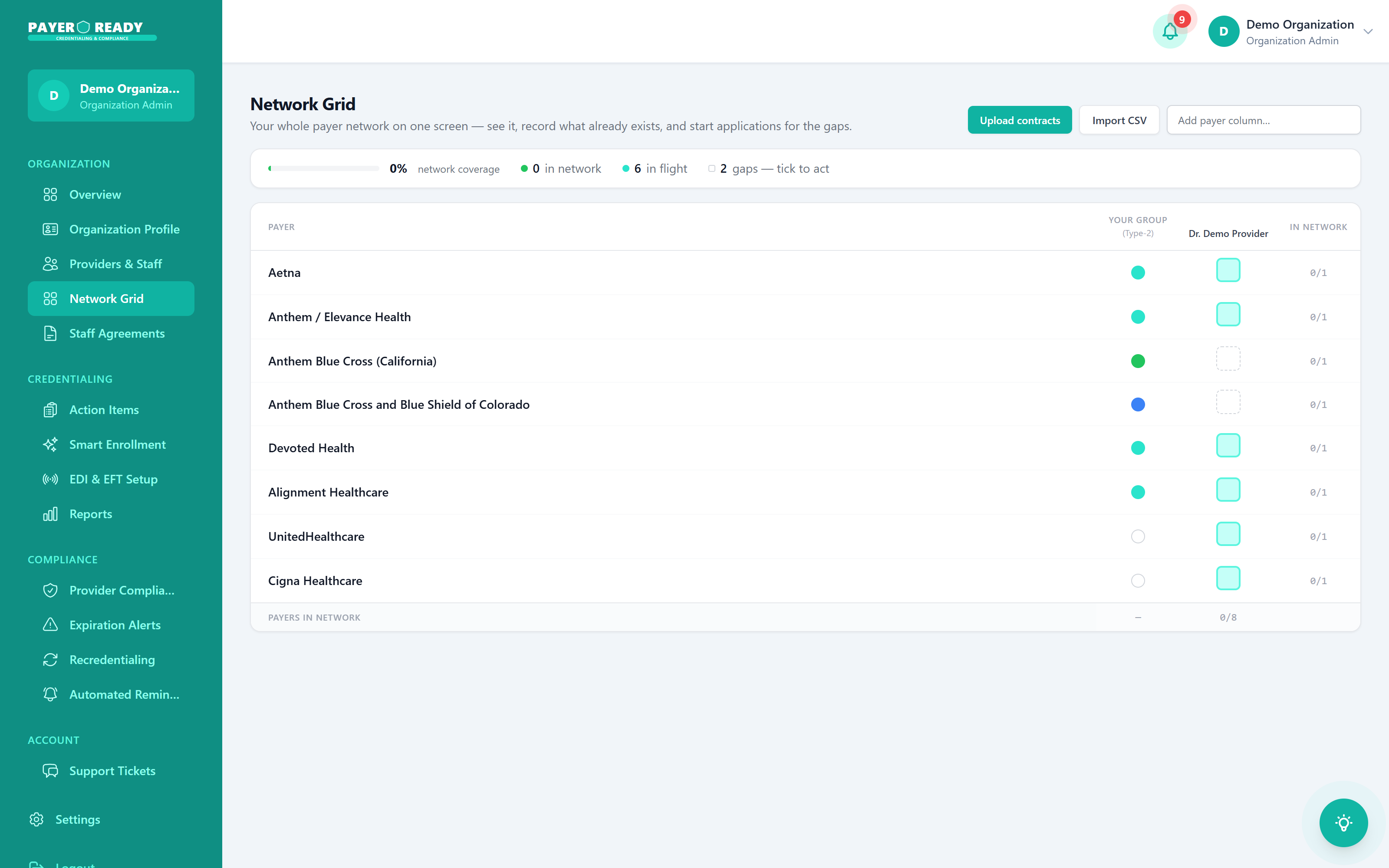
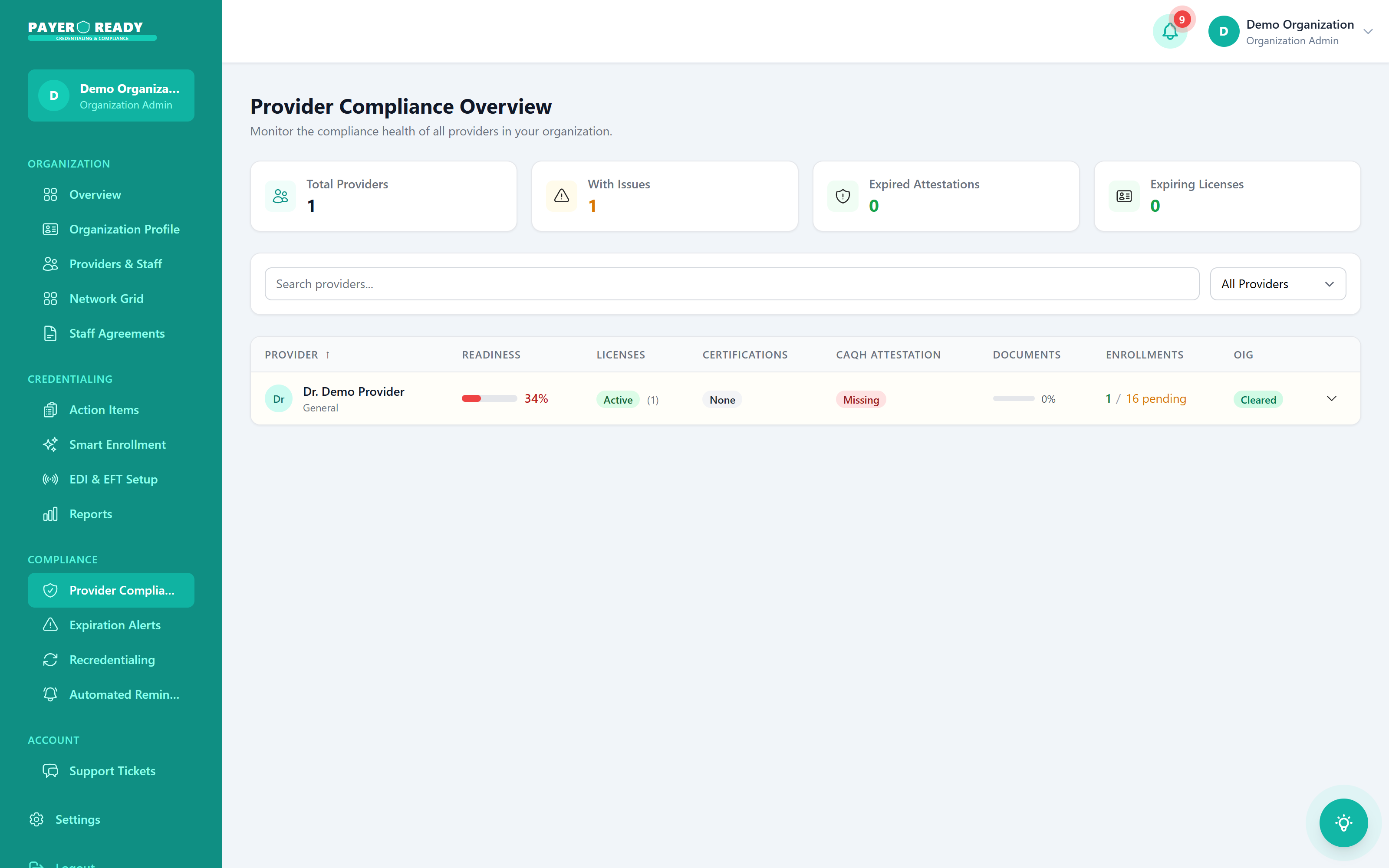
Readiness scored across every client
Each client practice gets its own roster and compliance view, and your team works across all of them from one login. Before a billing cycle starts, you can see which provider at which client has a lapsed license, an overdue CAQH attestation, or an unfinished enrollment, and fix it before it becomes a denial batch.
- Per client rosters with readiness per provider
- OIG and SAM screening across the whole book
- 90, 60, and 30 day alerts before anything lapses
A credentialing service line without the headcount
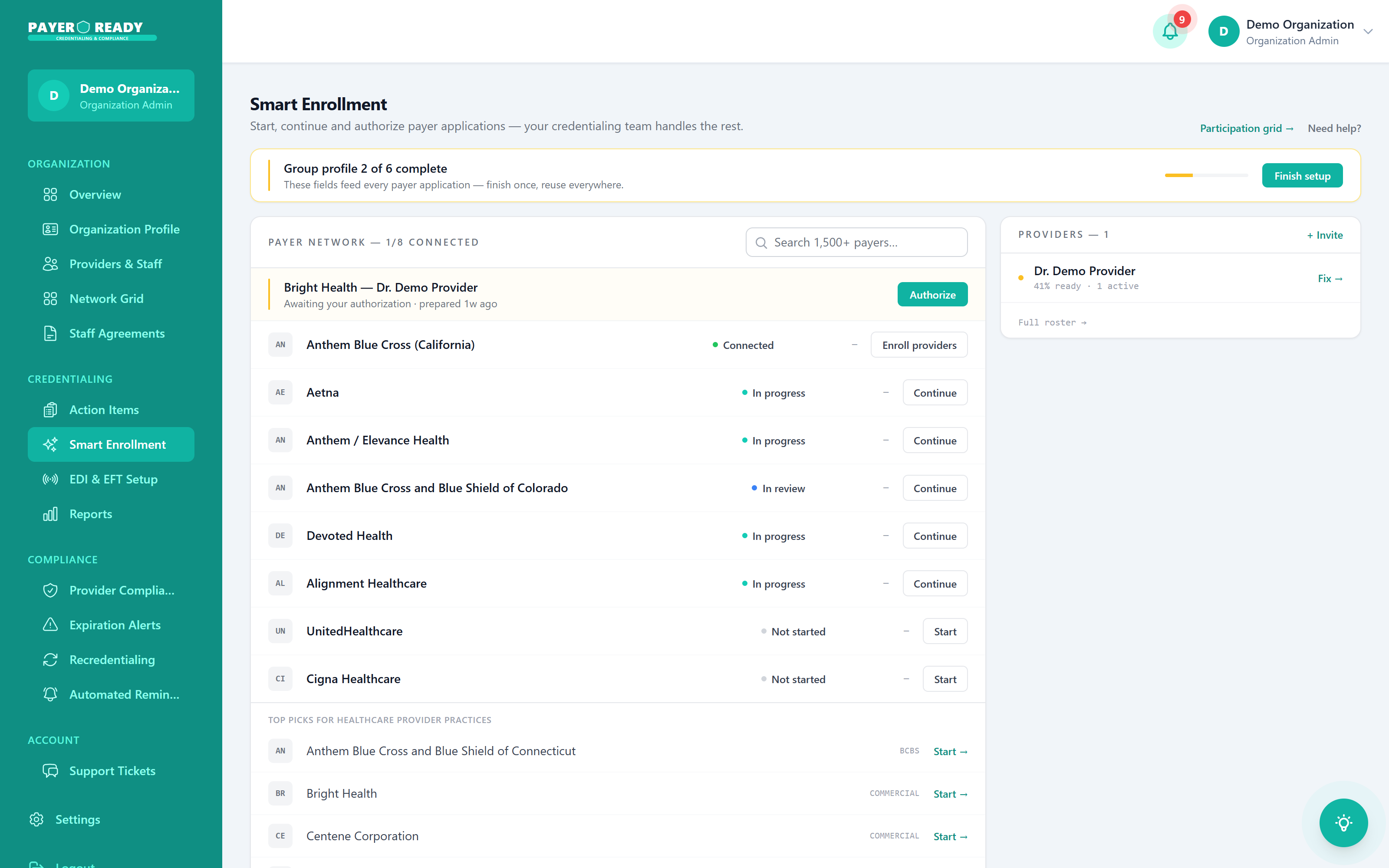
Offer credentialing to your clients without hiring a credentialing department. Your clients get enrollments worked on a two week follow up cadence by PayerReady specialists, you get the differentiator and keep the relationship. We stay in our lane: we never touch claims, and the final say on every submission stays with you and your client.
- Specialists prepare, submit, and chase every application
- Every payer response logged on the file your team can read
- Client relationships and billing stay entirely yours
Credentialing failures are billing failures wearing a disguise
Your analysts see them as denial codes. Your clients feel them as missing revenue. The root cause sits upstream of both.
The provider enrollment denial family
CO-183, CO-8, B7: adjudication codes that all translate to the same sentence, the rendering provider was not properly enrolled with this payer on the date of service. They are unappealable in the ordinary sense because the payer is right. The only fix is upstream, before submission.
Rework that never invoices
Every credentialing denial consumes analyst time twice: once to research why a clean looking claim died, once to resubmit after the enrollment is cured. That labor rarely gets billed back to anyone. It quietly compresses your margin on every affected client, month after month.
Client churn traced to onboarding stalls
When a client adds a provider and that provider sits unbillable for five months, the client does not blame the payer. They blame their billing partner. Time to first clean claim is the number new clients judge you on, and credentialing is usually what is holding it hostage.
The credentialing arm your firm never had to build
Full scope, across every client roster you manage, with your firm in front.
Multi client roster operations
Each client organization gets its own roster, network grid, and compliance view. Your team works across the whole book from a single login with per client separation intact.
Enrollment worked to approval
Applications prepared against payer specific requirements, submitted, and chased on a two week cadence with every response logged where your analysts can read it.
Participation gap detection
The Network Grid crosses every payer with every provider per client. Gaps surface as actionable tiles before a submitted claim finds them the expensive way.
Continuous compliance screening
Licenses, DEA registrations, certifications, and CAQH attestations tracked across every client, with OIG and SAM exclusion screening on a standing schedule.
EDI, ERA and EFT enrollment
Electronic claims routing, remittance, and deposit enrollment configured payer by payer for each client, so your posting workflows receive 835s instead of paper.
Reporting your clients can see
Enrollment progress, license status, and compliance standing exportable per client as PDF or CSV, ready to drop into your monthly client reviews.
How the partnership runs
Four steps to a credentialing service line, with clean boundaries the whole way.
Step one
Bring a client roster
Register the client organization, add providers by NPI with NPPES prefill, or invite them to complete their own profiles. Existing in flight applications get picked up and their true status verified.
Step two
We run the files
Specialists prepare and submit every application, work CAQH and PECOS, and chase payers on a two week cadence. Volume pricing applies across your combined book: $119 per application at 51+ providers.
Step three
Your team supervises
Analysts watch the Network Grid and compliance views instead of payer hold music. Readiness surfaces per provider before each billing cycle, and every payer response sits logged on the file.
Step four
Your brand stays forward
You present credentialing as your capability in client reviews, backed by exportable per client reporting. The client relationship, the billing, and the final say stay entirely yours.
For billing partners
The unit economics of the partnership
What the credentialing arm costs, and what it quietly removes from your denial queue.
$0
per application at book volume
Your combined client rosters reach the 51+ provider band quickly, and stay there.
0
login across every client practice
Per client separation for the data, one console for your analysts to work the whole book.
0 weeks
maximum between payer follow ups
Enrollment files never sit unworked long enough to become next month’s denial batch.
0
payer relationships, all 50 states
Wherever your clients practice, the payer contacts and requirements already exist here.
RCM partnership questions, answered straight
Boundaries, pricing, and who owns what.
PayerReady acts as your verified data source. We deliver clean, organized provider data that your team can pull into whatever billing system you already use. No custom integration required to get started.
No, that is your expertise and we stay out of it. We make sure the provider is properly credentialed, enrolled, and compliant so that when your team submits the claim, it goes through the first time.
You can offer credentialing as part of your service without building the infrastructure yourself. Clients get faster enrollment, you get a value add that differentiates you from other RCM firms, and the client relationship stays entirely yours.
Provider licenses, certifications, CAQH attestations, and expiration dates are tracked automatically, with OIG and SAM exclusion screening on a schedule. The platform alerts you before anything lapses so your billing activity is always backed by current credentials.
Per application, banded by total roster size: $149 at 1 to 20 providers, $139 at 21 to 50, and $119 at 51 and up. An RCM firm managing several client rosters reaches the volume bands quickly, and you always see the price before an application starts.
Yes. Each client organization gets its own roster, network grid, and compliance view, and your team works across them from one login. You always know which provider at which client is blocking which payer.