For Telehealth Groups
Licensed in one state? We run the others in parallel.
Telehealth growth dies in sequential paperwork: one state board at a time, one payer at a time, months apart. PayerReady works your states simultaneously. One verified profile feeds every board application and every payer enrollment, and the whole expansion is visible on one dashboard.
4 states in flight
All running at once, all visible
Four states. Zero waiting in line.
Sequential expansion wastes a year. Every lane below runs at the same time: board application, then payer enrollments, then billing goes live.
Built for rosters that practice everywhere
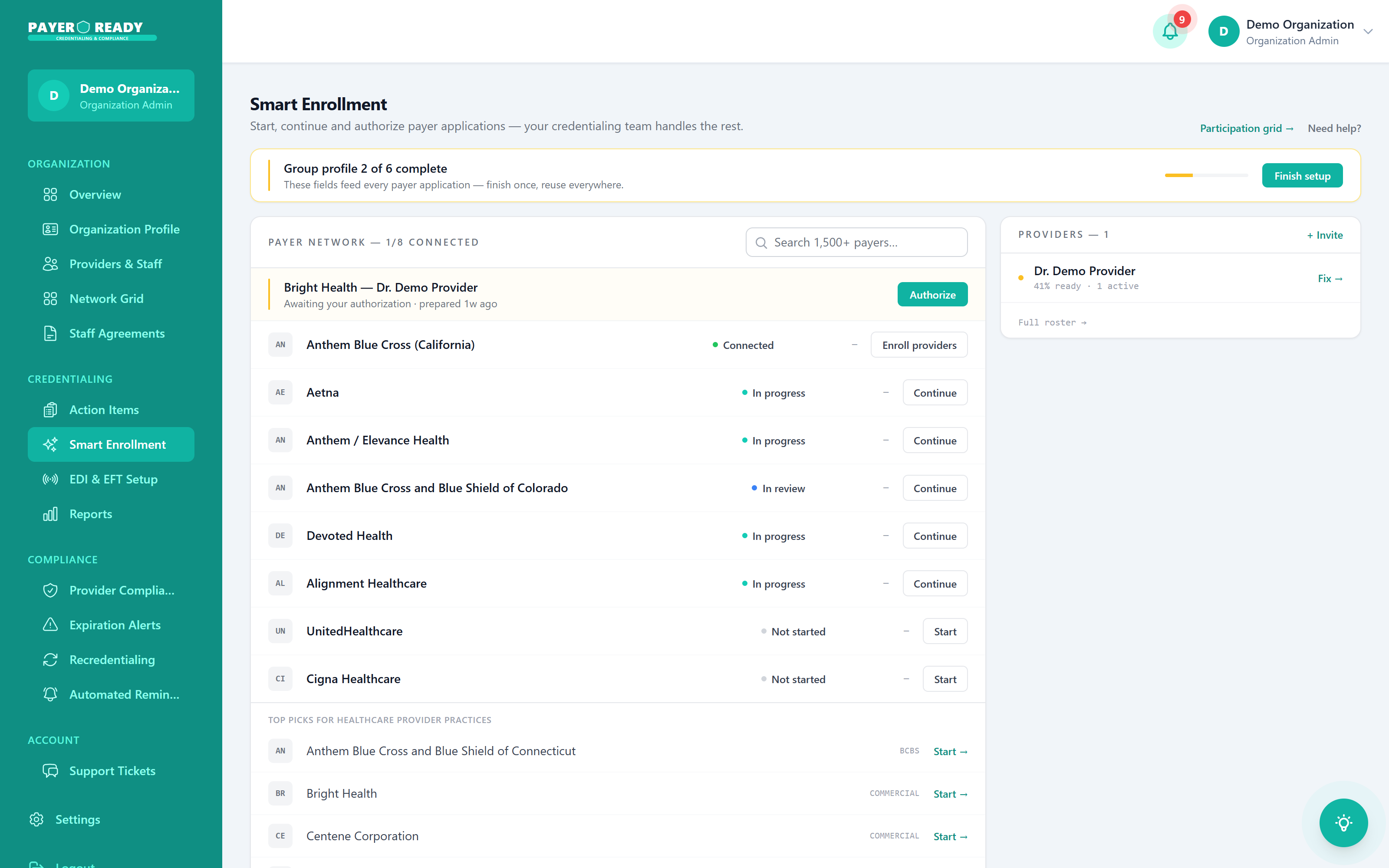
Real platform screens. This is the system your operations team runs the expansion from.
Remote providers, kept on task
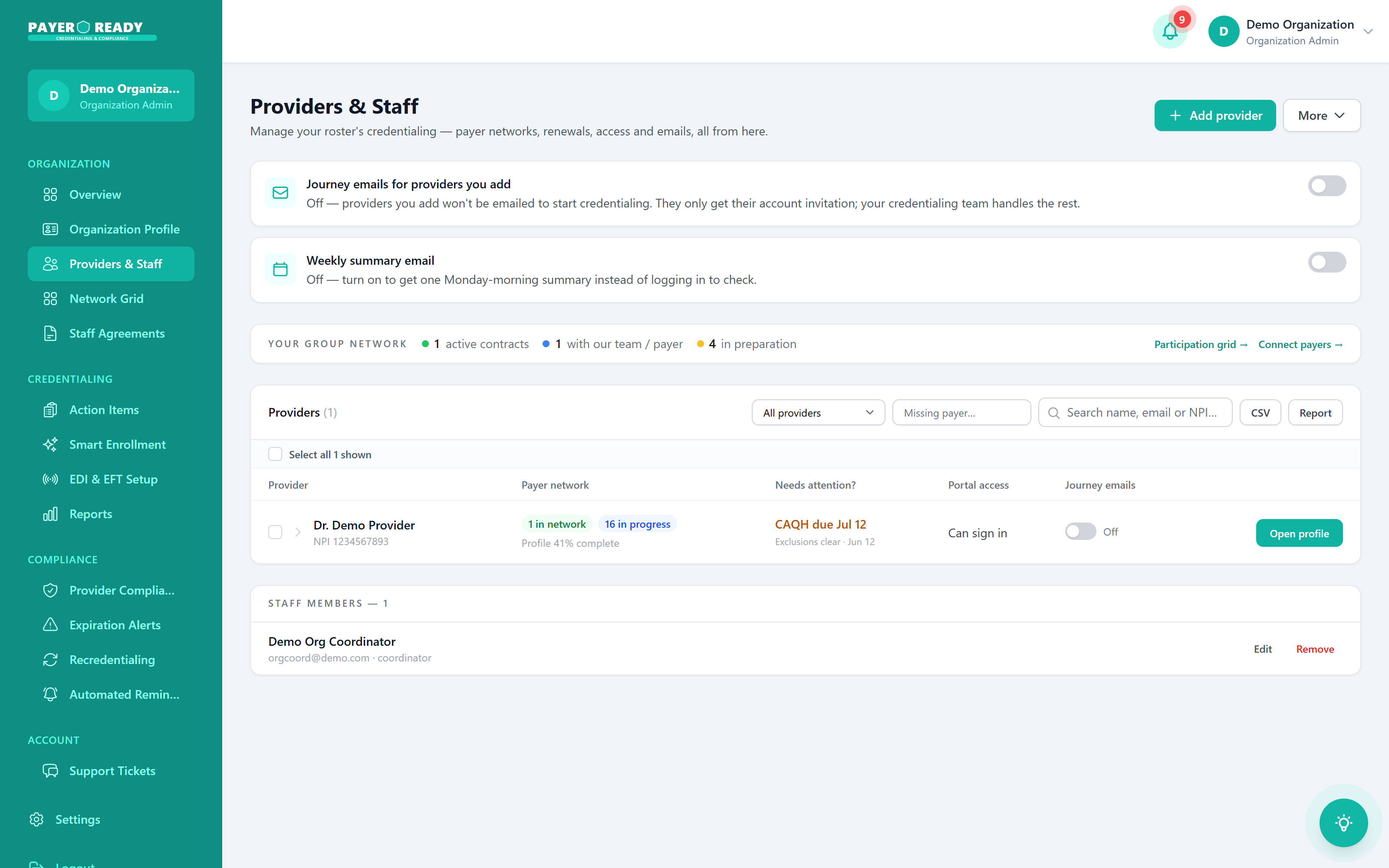
Your clinicians are in four time zones and none of them answer email fast. Assign what you need as tasks: a fingerprint appointment, a signature, an updated malpractice face sheet. They see exactly what to do in their portal, you see the moment it is done.
- Task assignment with real time completion status
- Providers upload once, documents reused per state
- Expirations tracked per state license at 90, 60, 30 days
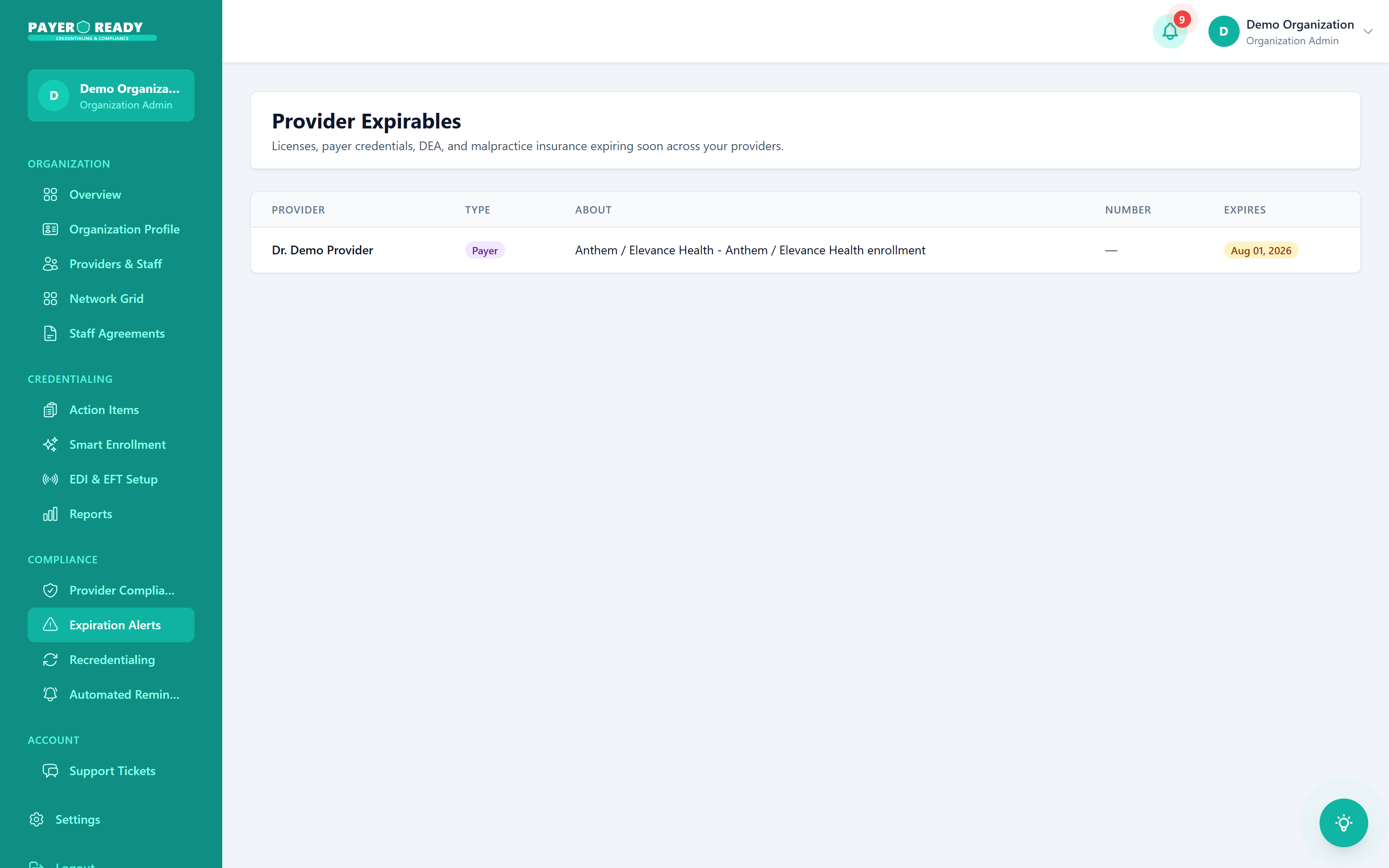
Renewal season across 12 states, handled
Every state renews on its own cycle, and a single missed date takes a whole state offline for your group. The Expirables view lines up every license, DEA, and attestation deadline across your footprint, so renewals get filed early and coverage never blinks.
- Every state license deadline on one screen
- Renewals worked by your specialist, not your ops team
- Compliance reports per state, exported in seconds
Why multi-state expansion breaks operations teams
Telehealth economics reward coverage. Telehealth paperwork punishes it. Fifty boards, fifty Medicaid programs, and every commercial plan in between.
Fifty boards, fifty rulebooks
Each state board has its own application, fee schedule, verification chain, and quirks: IdentoGO fingerprints here, notarized affidavits there, primary source verification everywhere. Learning each one from scratch is a tax your team pays once per state. Ours already paid it.
Sequential is a growth ceiling
A team that works states one at a time delivers one new market a quarter, and your patient acquisition roadmap inherits that pace. Run in parallel, the same states land inside a single window. The difference is not effort, it is architecture: one profile feeding many applications at once.
A licensed state is not a billable state
The license is the entry ticket, not the revenue. Until payer enrollment completes in that state, Medicaid and commercial encounters are unbillable there. Expansion plans that stop at licensure routinely strand months of clinical capacity. The enrollment leg has to be in the plan from day one.
The expansion stack, end to end
License, enroll, monitor: the three legs of every state, run as one motion.
State board licensing, all 50
Applications built to each board's checklist, verifications coordinated, fingerprints and notarizations scheduled, and board correspondence handled until the license posts.
IMLC Compact pathways
Where a physician qualifies for the Interstate Medical Licensure Compact, the Compact route gets used and the letter of qualification managed, cutting months off eligible states.
Per state payer enrollment
The moment a license posts, the prepared payer applications for that state go out: Medicaid, Medicare jurisdiction updates, and the commercial plans that matter in that market.
CAQH kept multi-state true
Practice locations, covering states, and attestations maintained so every payer pulling your CAQH ProView file sees the same current footprint your roster actually has.
Distributed team task management
Clinicians across time zones get their asks as tracked tasks with owners and statuses. Your operations lead sees completion in real time instead of chasing threads.
Per state compliance reporting
License status, enrollment progress, and expiration timelines filtered by state and exported as PDF or CSV, ready for compliance reviews and payer audits.
For telehealth operators
Expansion math, stated plainly
The constraint on your state map was never clinical capacity. It was paperwork architecture.
0
state boards, licensing end to end
Fees, forms, verification chains, and fingerprint logistics, each board handled on its own terms.
0
profile feeding every state and payer
One verified record populates every board application and every enrollment packet.
0
payer relationships for the enrollment leg
Because a licensed state does not produce revenue until its payers say in network.
0
states waiting in line behind another
Parallel is the architecture here, not a rush upgrade you pay extra for.
Telehealth expansion questions, answered straight
What operations leads ask before handing us their state map.
Significantly faster than doing it manually, because the states run in parallel instead of one after another. Your profile data populates every application automatically, our specialists handle each state board and its follow ups, and you track everything from one dashboard instead of juggling emails across states.
Yes. The platform supports multi-state licensing applications, including Compact pathways where the provider qualifies. Your verified profile serves as the single data source for all of them.
Assign tasks directly from your dashboard and track completion in real time. Remote providers see exactly what they need to submit, and you see when it is done, without email follow ups.
You can generate reports on license status, enrollment progress, and expiration timelines for any state. Filter by date or status and download as PDF or CSV for your compliance records.
The license has to exist before a payer application can be submitted in that state, but everything that can run in parallel does: the license application is worked while the enrollment packet is prepared and CAQH is updated, so the payer applications go out the moment the license lands.
Payer enrollment is priced per application, $119 to $149 depending on roster volume, and you see every price before anything starts. Licensing is scoped per state since board fees and requirements differ. No retainers and no charge for states you are not pursuing.