For Payers
A network you can trust on any given Tuesday.
Network integrity fails quietly: a license lapses in month seven of a three year recredentialing cycle and nobody knows. Files that live on PayerReady are monitored continuously, maintained by the provider at the source, and screened against OIG and SAM on a schedule. Your team sees the true state, always.
Monitored continuously
Not once every three years
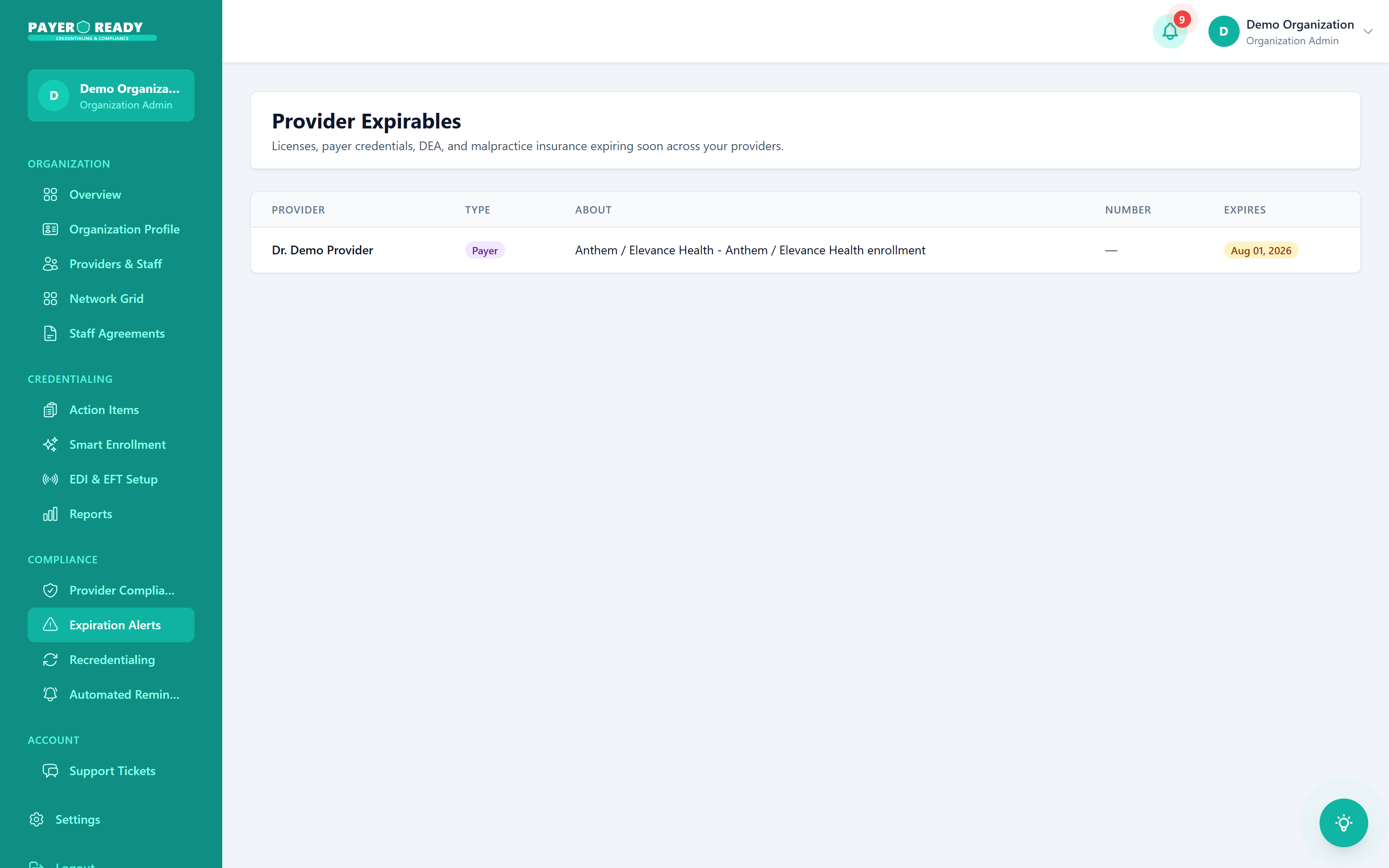
The network, watched in real time
Every tile is a provider file. When a credential drifts toward expiration, it surfaces, gets worked, and returns to green, months before your recredentialing cycle would have found it.
Clean files in, clean network out
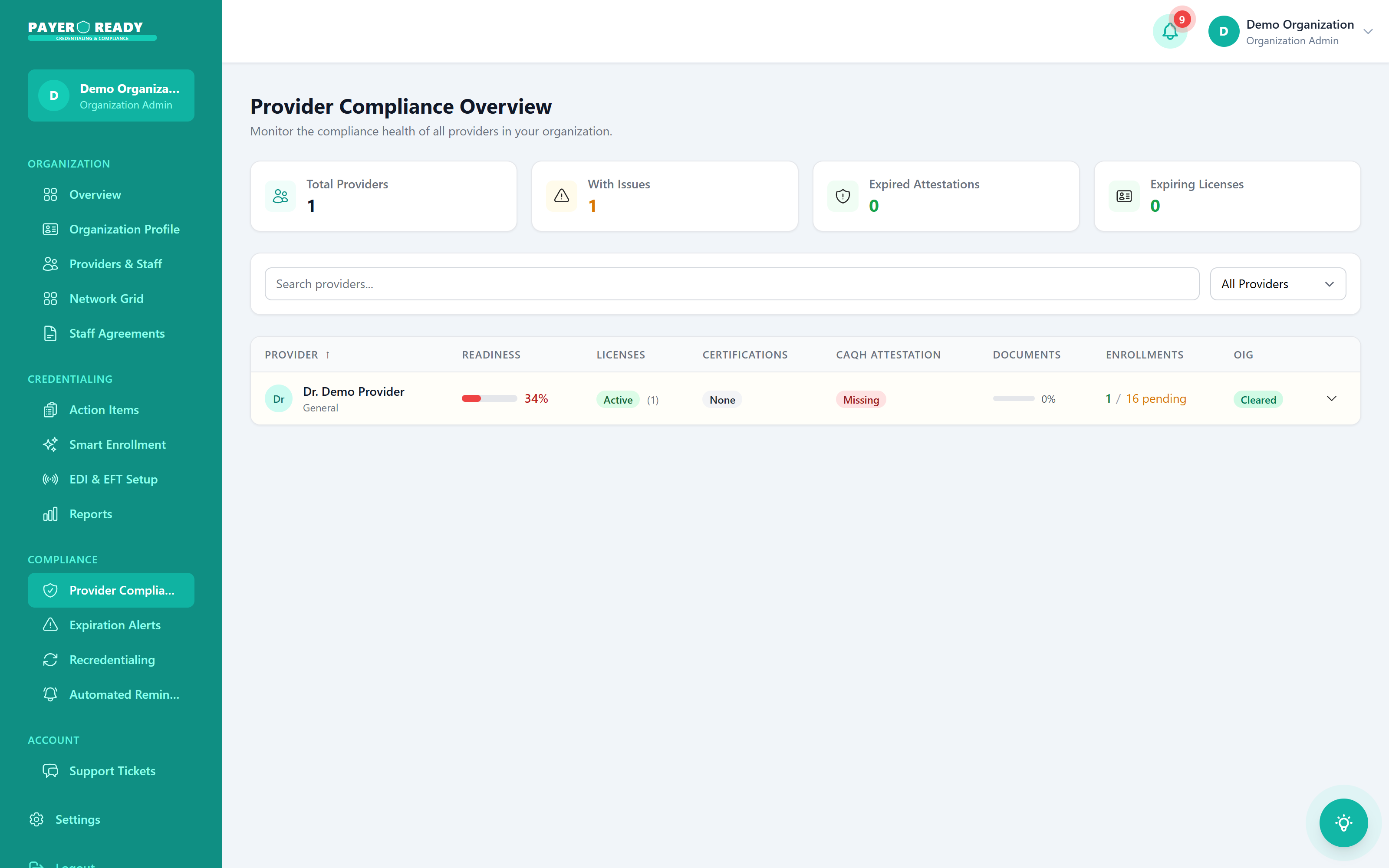
Real platform screens. The same record the provider maintains is the record your team reads.
Readiness you can check, not assume
Every provider on the platform carries a live compliance picture: license status, CAQH attestation, documents, enrollments, and OIG standing on one row. When your team pulls a file, that is the state of the provider today, timestamped and audit ready.
- Live license status: active, expired, pending renewal
- OIG and SAM exclusion screening on a schedule
- Timestamped records ready for audit requests
The gap between reviews is where networks decay
Credentialing verifies a moment in time. Networks live in the months after. That mismatch is the source of most integrity findings.
Thirty six months is a long time to look away
Between credentialing and recredentialing, licenses renew or lapse, DEA registrations expire, practice locations move, and providers occasionally land on exclusion lists. A file verified at month zero says nothing reliable about month twenty. Continuous monitoring closes that window.
Intake friction inflates turnaround stats
When applications arrive incomplete, your intake team burns cycles requesting corrections and your average days to decision climbs, a number providers, employer groups, and regulators all watch. Files sourced from provider maintained profiles arrive complete and keep that statistic honest.
Directory mandates with real deadlines
The No Surprises Act expects directory information verified on a 90 day cycle, and member complaints about ghost networks now reach regulators quickly. Demographics that flow from the provider's own maintained profile give your directory a defensible provenance trail.
What your network team gets from files on PayerReady
Six properties of every provider record, guaranteed by how the platform works rather than by promises.
Continuous license surveillance
Every license and certification on the file carries live status: active, expired, pending renewal, with alerts firing at 90, 60, and 30 days before any lapse.
Scheduled exclusion screening
Rosters screened against the OIG List of Excluded Individuals and Entities and SAM.gov on a standing cadence, not just at credentialing events.
Source-verified demographics
Addresses, locations, and contact data maintained by the provider, timestamped on every change, giving directory teams provenance they can show a regulator.
Complete document packages
License copies, DEA certificates, malpractice face sheets, and CVs attached to the record and current, ready for primary source verification workflows.
Audit-grade record keeping
Every credential, update, and screening result timestamped and retained, so responding to an audit request is a filtered export rather than an archaeology project.
Your authority, intact
PayerReady is not a credentialing verification organization making decisions for you. Your committee, your standards, your final say, working from cleaner inputs.
For network teams
Integrity, quantified
The measurable difference between an audit every three years and a heartbeat.
0
days a year the network is monitored
Credential drift surfaces in the long months a recredentialing cycle cannot see.
0/60/30
day alerts ahead of every expiration
Lapses get worked before they ever reach your directory or your members.
0
source of truth per provider file
Provider maintained demographics with a provenance trail you can show a regulator.
0
of the credentialing decision stays yours
We are not a CVO substituting judgment. We deliver verified inputs to yours.
Payer questions, answered straight
Boundaries and guarantees, stated plainly.
Providers maintain their own profiles: addresses, licenses, credentials, documents. Since they update it at the source, the data your team receives is always current, with no intermediary re-keying it.
No. We deliver the complete, verified data package. The credentialing decision stays entirely with your organization. We just make sure the file that reaches you is clean and complete.
Provider demographic data comes directly from the provider's own verified profile. That means your directory entries start with accurate data instead of stale information from last year's spreadsheet.
Yes. License and certification expirations are tracked continuously, and OIG and SAM exclusion screening runs on a schedule. Your team can check any provider's compliance status at any time and get alerts before anything lapses.
The provider is alerted at 90, 60, and 30 days, the renewal gets worked, and the file updates the moment the new credential lands. Your network view reflects the true state the whole way through instead of discovering the lapse at recredentialing.